For Forty Years My Hand Wrote With the Headless Horseman
Two clumsy handwritings for forty-five years, a morning spent choosing between them — and small letters that finally lined up. On the tempo of the hand and quiet in the head.
Quick Answer
My own handwriting appeared not when I stopped trying, but when an inner observer recognized what was foreign: both the school slant and the Arabic-style script were the Headless Horseman. In the same harmony I know from nail-standing, the hand wrote small and even — and I simply recognized it.
TL;DR | Quick Summary
I just came through a few days of forced rest. And for the first time in a very long while I actually relaxed — not merely stopped working, but shed the constant sense that I urgently needed to do something, solve something, run somewhere.
This morning I suddenly wanted to write on paper with a pen.
I do not know what came over me. For years almost everything I write goes through a keyboard. Code, messages, notes — all of it lives on a computer. I touch-type, very fast, and pen and paper have not been tools I need for practical tasks in a long time.
But a notebook turned up. So did pens. I sat down to write.
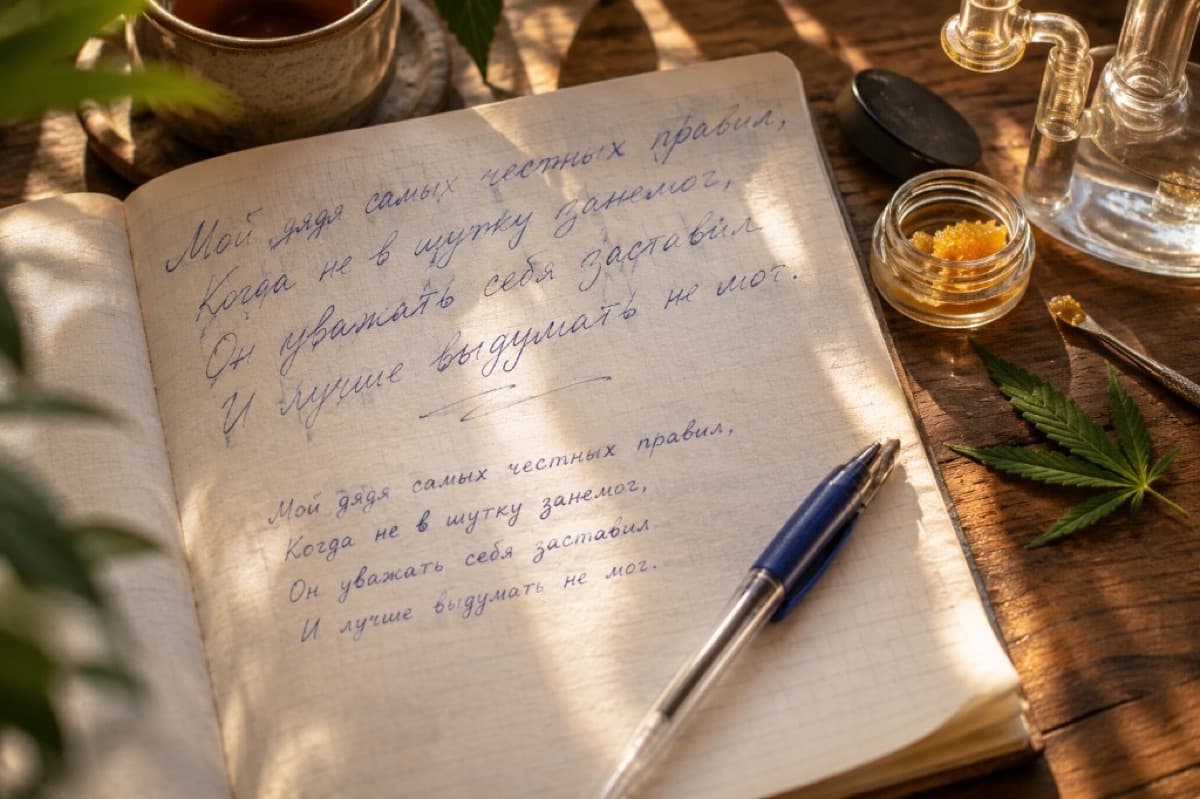
I started, of course, with the classics:
My uncle, of most honest fraternities,
When he fell gravely ill, not in jest,
Compelled himself to earn respect—
And no better scheme could he contrive.
For as long as I can remember wanting to write “just something,” these four lines from Eugene Onegin are what my hand reaches for.
Two handwritings and not one of my own
All my life I have had two ways of writing.
The first is ordinary, school-style, with the traditional rightward slant they taught us in copybooks. The second is something I call mine: letters leaning left, elongated connections, in places like Arabic calligraphy.
Both, frankly, are clumsy.
I have always admired people with beautiful handwriting. You look at someone else’s page and every letter sits where it should, lines stay level, everything is elegant and neat. Almost a work of art.
That never happened for me.
Letters of different sizes. Lines drifting away. Slant changing mid-word. Sometimes it felt as if my hand was shaking.
I used to wonder: is it constant inner tension? Am I always rushing somewhere? Lately, does cannabis add to that revved-up feeling?
Though if I am honest, my handwriting was worse long before cannabis entered the picture.
I took it calmly. Clumsy is clumsy. Not everyone is a calligrapher.
Today I finally decided to choose between the two.
I write with one or the other depending, I think, on how fast I need to go. One is faster. The other looks prettier. This morning I sat down to choose.
Almost at once I saw that both came out ugly.
There is a tremor. The hand seems to tear ahead and outrun the letter that still needs its tail finished. I take the traditional right slant — large letters come out crooked: the line holds for a while, then the hand slips sideways or upward. I take the left-leaning one, half Arabic script — ornate and slow. Extra motion. Also not mine.
OK, then I turned on the inner observer.
The Arabic script is not me. The school slant in the other direction is not me. Someone third is writing. A human stump inside, a trained phantom, an inner child-robot. The Headless Horseman.
Bull strength trying to draw the letter. Trying from the lesson, with all its might. That is why this has not been my handwriting for a long time.
I loosened my wrist, looked for another motion, tried by feel: like this, like this, like this. Wanting it to be beautiful too. Sometimes a line would start to work — and in the same second I felt myself rush. I told myself: I am not obliged to hurry.
When full harmony finally gathered — the same harmony I know from standing on nails — the handwriting appeared.
I recognized it. I did not learn it or drill it in again. I saw it and recognized it. Now I can write this way.
The letters were small, clear, even. They joined themselves, did not bounce along the line, came out without strain.
Turns out I can write beautifully.
I just spent forty-five years trying to write too large.
Handwriting is not taught, it is recognized
In childhood they teach you how to hold a pen, sit at a desk, copy letters from a model. That makes sense: a child has to start somewhere.
But training ends and the template remains. For years we repeat what we were taught without checking whether it fits us. I never chose my handwriting. I wrote the way they taught, shifted the style a little, got used to it. That is how the Horseman settled into my hand.
The strangest part is that my handwriting did not need to be acquired. No exercises, no calligraphy classes, no hundred-dollar pen. It did not need to be learned — it needed to be recognized. It seems it was always there. The Horseman’s effort simply kept it out of sight.
I had nothing I needed to record. Nowhere to rush. No result to force. Even the text did not matter.
At some point I felt that writing has its own rhythm.
Not only the rhythm of the hand. As if the form of written language itself sets a pace for thought.
A letter must begin, travel its small path, join the next. A word must gradually appear on the page. You cannot physically jump to the end of a sentence and skip everything in between.
A keyboard runs on a different tempo. I can type three hundred characters a minute, jump between windows, fix what I wrote, think about five other things at once.
Here there is only pen, paper, and a sequence of movements.
I even imagined that over centuries writing settled into its own natural frequency. Nobody encoded it on purpose. It is a rhythm that grows from the shape of letters, how they connect, and familiar human gestures.
A kind of carrier wave for the mind.
Fall into that rhythm and thoughts begin to move with the hand.
Maybe that is today’s fantasy. The feeling was very clear.
For the first time I wondered: maybe part of my habitual anxiety and inner hurry is simply that I live at too high a tempo?
Always faster. Write, reply, invent, fix, switch to the next task.
And then it turned out you can just write. Slowly. And lose nothing.
We have written about that same tempo — not chasing life, but getting out of your own way — in our piece on Thai sabai-sabai.
Try it sometime
I do not know if this will still be here tomorrow. Maybe my hand will rush again and lines will crawl up and down.
The Horseman has not vanished. He still lunges forward and tries with all his might. Only now I see him — and I can choose not to hand him the pen.
It took me forty-five years to notice a simple thing: sometimes the problem is not that you cannot do something. It is that you have spent your life doing it in a way that is not yours.
I also stumbled on an activity that can, at least for a while, switch off the endless inner race.
So if you have a free morning, take out an ordinary notebook and pen. Not for plans, not for a journal, not for another virtuous habit.
Write something meaningless. Even “My uncle, of most honest fraternities.”
Look at your own letters. Try different slants, sizes, spacing. Feel where the hand is comfortable and where it is not.
And above all — do not hurry anywhere.
Maybe you will recognize your handwriting.
And maybe, along with it, a little quiet.
Visit OG Lab
Licensed farm and dispensary in Taling Ngam. Check the live menu before you drive over; from 20 g the price per gram is lower.